

A domain is the address of your website on the Internet – i.e. what you enter at the top of your browser (e.g. bscwebdesign.at ). It works like a street address: Without a domain, nobody can find your website, even if it were technically already online.
Definition in one sentence:
A domain is the unique name (address) under which a website can be reached on the Internet – for example bscwebdesign.at or google.com.
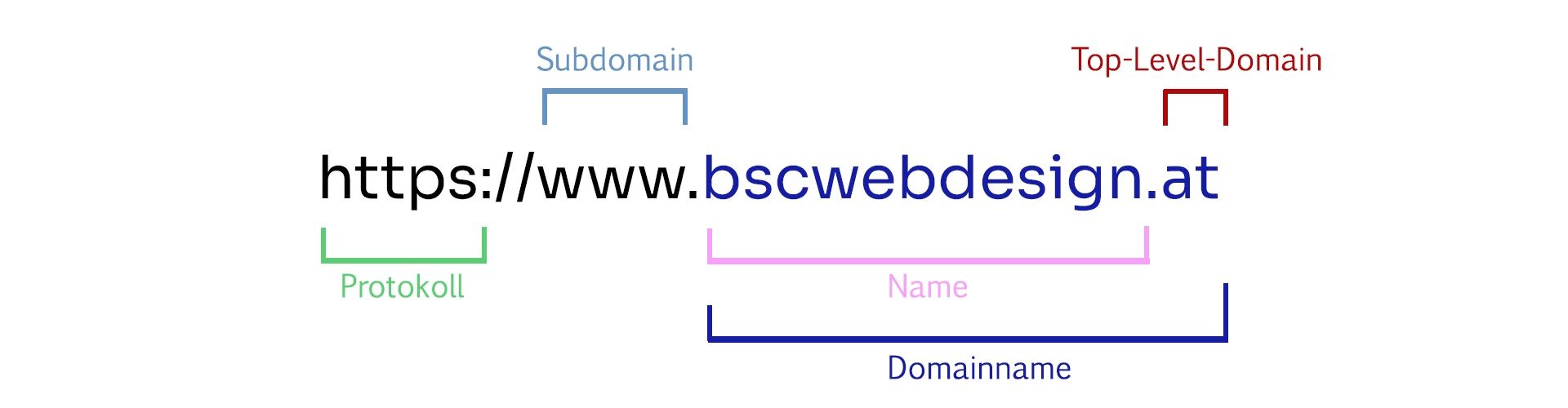
This is how a domain is structured: Protocol, subdomain, name and domain extension
How is a domain structured?
A domain (or web address) consists of several parts. The graphic above shows you the typical structure – explained briefly and simply here:- Protocol (https://) – shows that the connection is encrypted (secure data transfer)
- Subdomain (www) – an optional addition before the domain (e.g. “www” or “blog”)
- Name (bscwebdesign) – the actual domain name that you remember
- Top-level domain (.at) – the ending (often country or category, e.g. .at, .de, .com)
Examples of domains (simple)
To give you an immediate feel, here are a few typical examples:- google.com – domain name “google” + extension “.com”
- orf.at – domain name “orf” + extension “.at”
- amazon.de – domain name “amazon” + extension “.de”
- bscwebdesign.at – Domain name “bscwebdesign” + extension “.at”
Domain ≠ Website ≠ Hosting (important difference)
Many people confuse these terms – but it’s actually quite logical:- Domain = the address (e.g. bscwebdesign.at)
- Hosting = the storage space/server where the website is located
- Website = content (texts, images, pages) that visitors see
Tip:
If you are unsure how to choose a good domain name, take a look here:
Find a domain 2025 – how to choose the right name.
Which domain extension should I choose?
The suffix at the end (.at, .de, .com) often influences trust and recognition. For many Austrian companies, .at is ideal – international projects often use .com.Conclusion: Why a domain is so important
A domain is the basis for your online presence: it makes your website findable, memorable and professional. Without a domain, people can’t easily access your site – and without a good domain, a project quickly looks “unfinished”.- Domain = address of your website
- It influences trust & recognition
- It is the basis for e-mail addresses (e.g. hello@deinedomain.at)
- It is the starting point for SEO, branding & marketing
Next step:
If you want to plan your website from A to Z (domain → hosting → system → content), take the main guide:
Create a website 2025 – step-by-step guide.
FAQ – short & simple
What is a domain, simply explained?
A domain is the address of a website on the Internet. It makes it possible to access a website via a name such as bscwebdesign.at instead of via a complicated IP address.What is the difference between a domain and a website?
The domain is just the name or address. The website is the content (text, images, pages) that is displayed at this address.What is the difference between domain and hosting?
The domain is the web address. Hosting is the storage space/server on which the website is located. Both together make your website accessible.What does “www” mean before a domain?
“www” is a subdomain. Many websites work with and without www – it is only important that one version is defined as the main version.What is a subdomain?
A subdomain is an addition in front of the domain, e.g. blog.deinedomain.at or store.deinedomain.at. It is often used to separate areas such as blog or store.Which domain extension is best?
For Austrian companies, .at is often the best choice because it creates regional trust. For international projects, .com can make sense. You can find details here: Domain extensions in comparison.How much does a domain cost?
A standard domain usually costs around €10-20 per year, depending on the extension. Some premium domains can be significantly more expensive.Can a domain also be “reserved”?
Yes, you can register a domain even if you don’t build the website until later. Many people secure the name first and then start with hosting & website.