AI visibility: how ChatGPT & Google decide which businesses to name
When do ChatGPT, Perplexity and Google mention your business? When they find it described the same way in several reliable sources, are allowed to read your pages, and can point to a page that answers the exact question. There is no secret trick: according to Google, appearing in AI Overviews needs no special optimisation, just solid SEO fundamentals.
We tested this on ourselves. On 3 November 2026 we asked Perplexity, ChatGPT and Google ten typical questions and recorded when BSC Webdesign was named and where the AI got its information. Below you’ll find the results and six levers you can use for your own business.
1. What AI visibility means
Classic Google search gives you a list of ten links and you decide where to click. AI search tools such as ChatGPT, Perplexity, Gemini or Google’s AI Overviews answer in full sentences instead. They often name two to five providers and explain why. If you’re not in that answer, you’re not even on the shortlist.
AI visibility means your business is mentioned in those answers, described correctly and ideally backed by a link to your website. You’ll also hear the terms AEO (answer engine optimisation) and GEO (generative engine optimisation). Both mean the same thing: preparing your content and business details so an AI can find them, understand them and pass them on.
One important point: AI visibility doesn’t replace search engine optimisation, it builds on it. Most AI search tools pull their information live from the web, and whatever is hard to find or contradictory there won’t make it cleanly into the answer either.
2. How AI search picks its sources
Every AI answer starts with a search step. The AI runs its own searches in the background, reads the pages it finds and summarises them. For the big providers, parts of this process are publicly documented:
- Google: According to Google, AI Overviews and AI Mode may issue multiple related searches across subtopics (“query fan-out”) to build a response. To be shown as a supporting link, a page must be indexed and eligible to appear in Google Search with a snippet. Google says there are no additional technical requirements.
- ChatGPT: OpenAI separates its crawlers by purpose. OAI-SearchBot fetches pages for search results in ChatGPT, while GPTBot collects content for training future models. You can allow or block each one separately in your robots.txt.
- Perplexity: PerplexityBot is designed to surface and link websites in Perplexity’s search results and, according to Perplexity, isn’t used to train AI models. Perplexity recommends allowing it in your robots.txt.
For “near me” style questions, a second source comes in: map data. In our test, ChatGPT and Google answered “Which agency in Vienna?” with a map of business profiles, star ratings and review counts. For ranking in these local results, Google names relevance, distance and prominence. According to Google, prominence also takes into account how many reviews and positive ratings a business has.
3. Our test: 10 questions, 3 AI search tools
In October 2026 we deliberately set up our own website, a web design agency based in Vienna, Austria, for AI search. Then, before giving you advice, we wanted to know what AI search actually says about us. Here’s how we did it:
- Ten questions the way potential clients ask them: general recommendations, industry questions (medical practice, winery), costs, funding, one question about our district of Margareten, two questions directly about BSC Webdesign and one question in English. The other nine were asked in German, as our clients would.
- Three AI search tools: Perplexity, ChatGPT with web search and Google Search with AI Overview.
- Logged out and in a new session each time, so no history could influence the result.
- Recorded: whether we were named, in which position, with which details and from which sources.
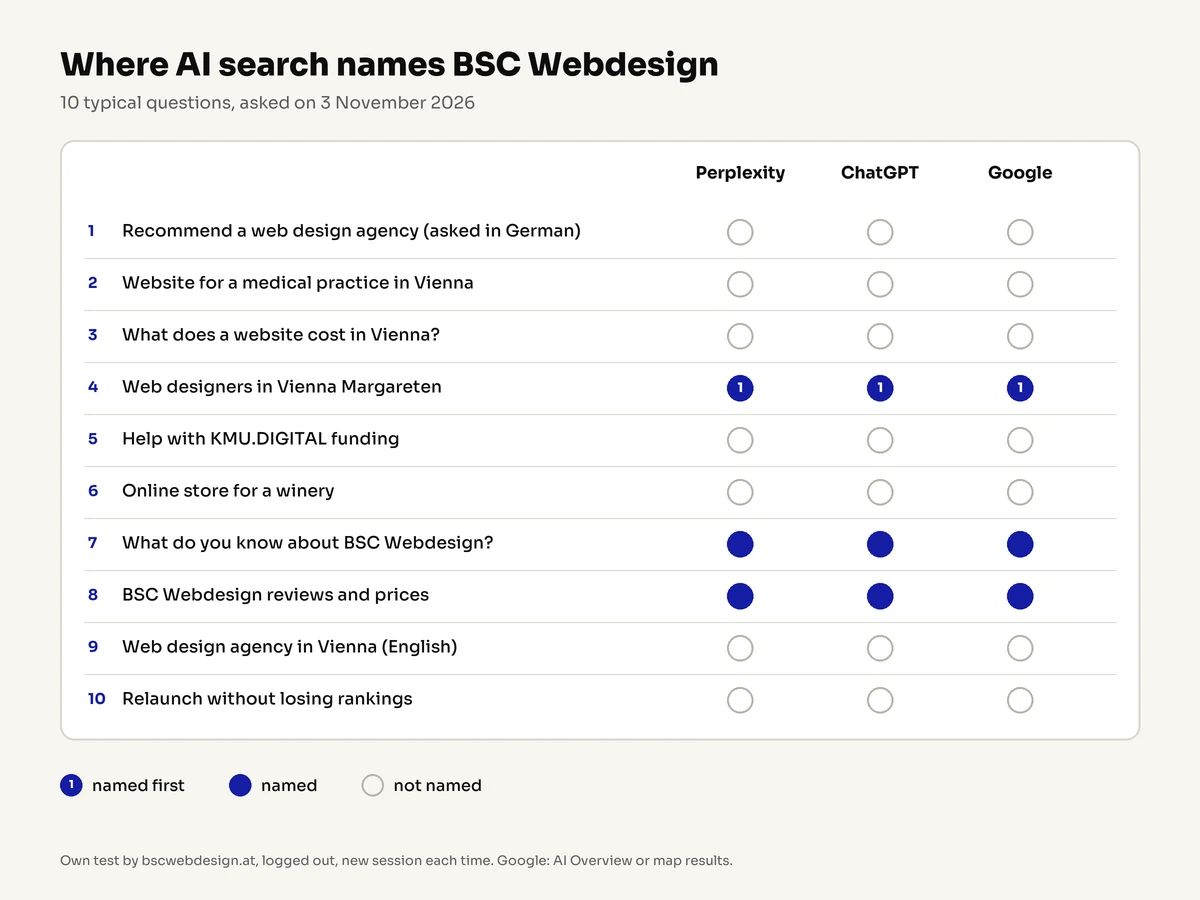
The result in one sentence: anyone asking about us or our district reliably gets our name. Anyone asking generally for an agency gets other names.
In detail:
- Question about our district (Margareten): All three tools name BSC Webdesign first, with the correct address and our starting price. The sources differ: Perplexity uses our English home page, ChatGPT our profile on the agency platform feedbax, Google our Google Business Profile.
- Questions directly about us: All three give a detailed profile. Founders, company register entry, the meaning of our name, services, references and Google rating are largely correct. Besides our website, the sources include Clutch, Sortlist, feedbax, Herold, Creditreform, the Austrian company register, LinkedIn and an article on the local news site MeinBezirk.
- General questions (“Which web design agency in Vienna can you recommend?”, also in English): we don’t appear. ChatGPT and Google build the answer from map data. The agencies they name have between 43 and 145 Google reviews, which is why collecting reviews is a priority for us right now too. Perplexity relies on comparison lists from other websites (“the best agencies in Vienna”) and platforms such as Clutch and Sortlist.
- Industry and topic questions (medical practice, winery, relaunch): the providers named are the ones with a dedicated service page or a specific reference for exactly that, such as a dedicated offer for doctors’ websites or a documented winery online store.
- Cost and funding questions: here the AI names no agency at all, just price ranges and points of contact. The sources are guide articles and official pages.
4. What we learned
The 30 answers show four patterns that apply not just to agencies but to any business with local customers:
- Consistent details pay off. Since mid October, our short company description has appeared in exactly the same words on our website, in our structured data, on our About page and in six external profiles. For the brand questions, all three AI tools repeat exactly these facts.
- The more specific the question, the more likely a smaller business is named. For “agency in Vienna”, the providers with the most reviews and the most mentions in lists win. For “web designer in Margareten”, the business that is based there and says so clearly everywhere wins.
- External profiles are not a box-ticking exercise. ChatGPT found us for the district question through our feedbax profile, not our own website. Business directories, review platforms and company register entries act as outside confirmation for AI search.
- Topic pages win topic questions. If you want to be named for “website for a medical practice”, you need a page that offers exactly that and references that prove it. A general service page isn’t enough.
5. Six levers for your business
This leads to six areas you can work on. They’re roughly ordered by effort: quick wins at the top, an ongoing project at the bottom.
- 1. Let AI crawlers in. Check your robots.txt (yourdomain.com/robots.txt) to see whether OAI-SearchBot, PerplexityBot or Googlebot are blocked. Sometimes your hosting blocks them too: in October, GPTBot got a “too many requests” response from our host’s firewall on some pages, even though our robots.txt allowed everything. You’ll only see this in your server logs or by fetching a page the way a crawler does. Whether you allow training (GPTBot) is your call. For search, the search crawlers are what matter most.
- 2. One description, used everywhere. Write one sentence that fully describes your business: who, what, where, for whom. For example: “Smith Electrical is an electrical contractor in Leeds for homeowners and small businesses across West Yorkshire.” Use it on your home page, your About page, your Google Business Profile and every directory. Your name, address and phone number belong there too, always in exactly the same format.
- 3. Complete your Google Business Profile and collect reviews. Category, services, opening hours, photos and a description using your sentence from above. Above all: actively ask happy customers for a review, ideally right after the job with a direct link. The number of reviews was the clearest difference between named and not named providers in our test. More on this on our local visibility page.
- 4. Answers, not slogans. AI search picks up sentences that answer a question on their own. “We build websites that think ahead” is nothing an AI can pass on. “A website with five pages takes four to six weeks with us” is. Write down your customers’ questions and answer each one directly in the first sentence, on the right page or in an FAQ section. Google recommends helpful content written for people rather than for search engines anyway.
- 5. Add structured data. The LocalBusiness schema describes in machine-readable form who you are, where you’re based and when you’re open. Google’s documentation explains which properties are supported, such as address, phone number and opening hours. On WordPress, SEO plugins handle part of this, but you often have to add address and opening hours yourself.
- 6. Mentions beyond your website. Listings in industry directories, profiles on review platforms, your chamber of commerce entry, a story in the local paper or a mention in a comparison article. Every industry has its own platforms. Search your most important question in Perplexity and look at which sources it links: that’s where you want to show up.
A word on llms.txt: it’s a proposal for an overview file that shows AI systems a website’s key content in short form. It isn’t an official standard adopted by the big providers. We have one because it takes little effort. But it has to be just as up to date as your website, more on that below.
6. When AI repeats outdated information
The most surprising part of our test: for the brand questions, the AI tools were well informed, but not always up to date.
- All three described the roles of us three founders in an older version. Our website and profiles were already updated, but an overview file for AI systems still had the old details. Finding gaps like this is exactly what such a test is for, and we fixed it the same day.
- Google’s summary turned a one-time service into a monthly fee. Our website says no such thing.
The takeaway: whenever you change prices, services or contact people, change them everywhere at once, including profiles, PDFs and files like llms.txt. Expect AI search to take a few weeks to pick up the new version. And after any major change, check what the AI says about you. You can’t directly correct errors that come from outside, but the clearer and more consistent your details are, the less often they happen.
7. How to measure your AI visibility
There’s no tool that reliably tracks every AI answer for small businesses. Three simple methods still get you a long way:
- A fixed set of questions, once a month. Write down eight to ten questions your customers would ask and always ask them the same way: logged out or in a private window, in ChatGPT, Perplexity and Google. Record whether you’re named, with which details and from which sources. You can see our set of ten questions in the graphic above.
- Visits from AI search in Google Analytics. Under “Acquisition” you’ll find sources such as chatgpt.com, perplexity.ai or gemini.google.com. From February to October 2026 we had 122 such visits, 85 of them from ChatGPT, around 0.5% of all measured visits. Only visitors who accepted cookies are counted, so the real number is higher.
- Just ask. Many people who find you through an AI type your address in directly afterwards and don’t show up as AI visits in your analytics. Ask in the first call or in your contact form: “How did you find us?”
What matters is the comparison over time. A single test is a snapshot, because AI answers vary, even for the same question.
8. What doesn’t work
- Stuffing texts with keywords. AI search summarises content. A text that’s hard for people to read won’t give the AI a usable sentence either.
- Publishing AI-written articles in bulk. Twenty interchangeable articles without real experience achieve less than one article with genuine numbers and examples. It’s exactly that kind of first-hand information that gets quoted.
- Relying on llms.txt. It can help, but it replaces neither a well-structured website nor outside mentions.
- Setting up once and forgetting. Profiles, prices and contacts change. Outdated details in one source stick around in AI answers longer than you’d like.
If you’d rather not do all of this yourself: with our SEO services we take care of content, technology and visibility in both classic and AI search on an ongoing basis.
9. Sources
- AI Features and Your Website, Google Search Central
- Creating Helpful, Reliable, People-First Content, Google Search Central
- Local Business (LocalBusiness) Structured Data, Google Search Central
- Tips to improve your local ranking on Google, Google Business Profile Help
- Overview of OpenAI Crawlers, OpenAI
- Perplexity Crawlers, Perplexity
- The /llms.txt file, llmstxt.org
Information as of 3 November 2026. The test results come from our own test on the same day.
Conclusion
AI search names businesses it can back up: with consistent details on their own website, a well-kept Google Business Profile with reviews, pages that answer specific questions and mentions outside their own site. Our test shows this works for small businesses too, starting with specific questions such as your own neighbourhood. Showing up for general questions takes more reviews and more outside mentions, and that’s a project of months, not days.
Our SEO services combine classic search engine optimisation with visibility in ChatGPT, Perplexity and Google. In a free initial consultation, we’ll look at where you stand today.
FAQ
The most common questions about visibility in AI search, answered briefly.
What is AI visibility?
AI visibility means AI search tools such as ChatGPT, Perplexity or Google’s AI Overviews mention your business in their answers, describe it correctly and link to your website. It builds on classic search engine optimisation.
Do I need separate optimisation for AI search?
For Google, by its own account, no: AI Overviews follow the same fundamentals as regular search. In practice it still pays to focus on three things: consistent details everywhere, direct answers to specific questions and mentions beyond your own website.
How long does it take for AI search to pick up changes?
There’s no fixed timeframe and it varies. In our test, some answers still contained details we had changed on our website more than two weeks earlier. Expect a few weeks, then check again.
Do I need an llms.txt file?
It’s not a must. llms.txt is a proposal for an overview file for AI systems, not an official standard. If you create one, keep it as up to date as your website, or it will spread outdated information.
How can I find out whether ChatGPT knows my business?
Ask ChatGPT, Perplexity and Google while logged out or in a private window: once directly for your business name, and once the way your customers would ask, for example “electrician in Leeds for an old house”. Note whether you’re named and which sources are linked.