
Website running costs: what you pay every year
What does a website cost per year once it’s live? The fixed items are hosting, a domain and email, and many WordPress sites add licences for premium plugins. Hosting alone typically costs around €4 to €25 a month with European providers. You will find the prices and sources in the hosting section below. On top of that comes maintenance: updates, backups and checks that either take your own time or are part of a care plan.
Below you’ll find every recurring item with realistic yearly ranges, a real example of what happens when a licence runs out, and where it makes sense to save.
1. All running costs at a glance
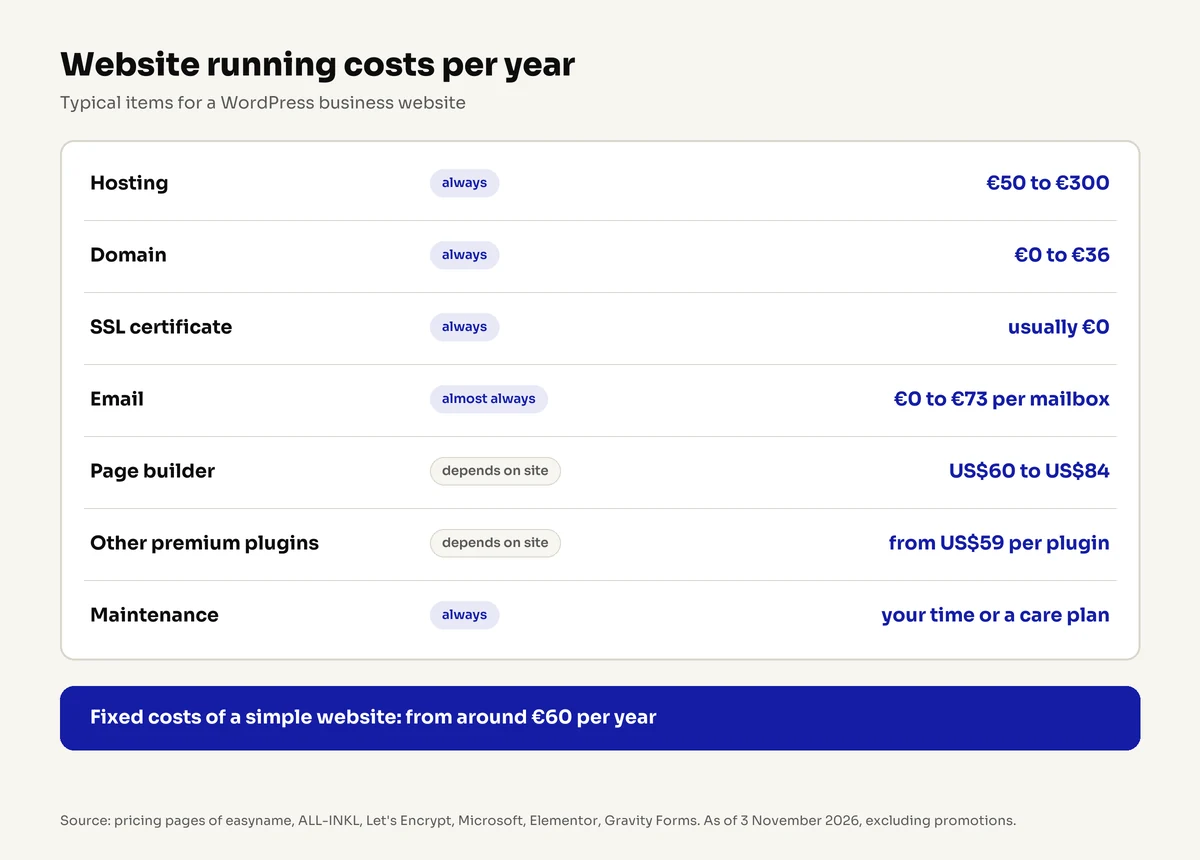
The one-off cost of a new website is usually well planned. What you pay every year after launch is easy to underestimate, because it’s spread across several small invoices. The table shows the usual items for a WordPress business website. For the one-off build cost, see our guide to website costs.
| Item | Needed? | Range per year | Note |
|---|---|---|---|
| Hosting | always | around €50 to €300 | depends on plan and performance |
| Domain | always | €0 to around €36 | often included in the hosting plan |
| SSL certificate | always | usually €0 | free with many hosting plans |
| almost always | €0 to around €73 per mailbox | included in hosting or a separate service | |
| Page builder (e.g. Elementor Pro) | depends on site | around US$60 to US$84 | renews every year |
| Other premium plugins | depends on site | from around US$59 per plugin | e.g. forms, bookings, shop |
| Maintenance | always | your time or a care plan | updates, backups, checks |
| Content and legal pages | ongoing | your time or a care plan | opening hours, prices, legal notice |
Add up only the fixed items and a simple website on a small hosting plan with the domain included comes to around €60 a year. With a bigger plan, a page builder, one more premium plugin and several separate mailboxes, you quickly reach a few hundred euros. Maintenance isn’t included in that figure yet.

2. Hosting
Hosting is the server space your website lives on, and it’s the biggest fixed item. European providers charge, for example, €4.40 to €21.50 a month at easyname or €4.95 to €24.95 a month at ALL-INKL. Over a year, that’s around €50 to €300. If you’re not sure what hosting actually is, read What is hosting?
When comparing plans, look at the price after the promotion. Many providers advertise a low introductory rate for the first few months, then the regular rate applies. At easyname, for example, the smallest plan costs €0.49 for the first three months and then €4.40 a month.
A normal business website usually needs a small to medium plan. More important than the last euro are servers in the EU, automatic backups and support you can actually reach. For our projects, we usually set up the hosting on behalf of our clients, so the technology and the website fit together from day one.
3. Domain and SSL certificate
The domain is your address on the web, such as yourcompany.com. Bought on its own, an Austrian .at domain at easyname costs a regular €3.00 a month, so €36 a year. Often it’s already part of the hosting plan: depending on the plan, ALL-INKL includes 3 to 10 domains. Which extension suits you is covered in our comparison .at, .de or .com.
The SSL certificate provides the encrypted connection (https) and the padlock in the browser. You usually don’t pay extra for it. The non-profit certificate authority Let’s Encrypt issues these certificates free of charge, and many hosts add them automatically, for example easyname with free SSL on every plan.
4. Email accounts
There are two ways to handle email. Many hosting plans include mailboxes, at easyname for example unlimited email accounts, so there’s no extra cost. If you also need calendars, Teams or Office apps, you’ll usually use a separate service: in Austria, Microsoft 365 Business Basic costs €6.07 per user per month on annual billing, excluding VAT. That’s around €73 per person per year.
Many businesses already have email with a service like this before the new website arrives. That’s fine: mailboxes keep running independently of the website. Just make sure the domain’s email settings come along if the website ever moves to another host.
5. Premium plugin licences
Many WordPress sites use paid extensions, such as a page builder for the design or a form plugin with advanced features. These licences usually run for a year and then renew. Elementor Pro for one website costs, for example, US$60 to US$84 a year, and the form plugin Gravity Forms from US$59 a year.
In our projects, Elementor Pro is included and runs on our licence for as long as we look after the website. If the care plan ends, we detach the website from our licence. If you want to keep using the Pro features after that, you’ll need your own licence. We talk this through with you beforehand, so nothing disappears unexpectedly.
We’ve seen how much a valid licence can matter with one of our clients: her contact form suddenly stopped working properly. The form logic came from a premium plugin, and its licence had expired because it wasn’t renewed. What happens without a valid licence depends on the plugin. Some keep working and just stop getting updates, others switch features off. With a contact form, you often only notice when enquiries stop coming in.
Our tip: keep a list of every licence with its expiry date, and send yourself a test enquiry through your own form once a month.
6. Maintenance: updates, backups, checks
A website isn’t finished at launch. WordPress, the theme and every plugin get regular updates, often with security fixes. WordPress itself advises you to always update to the latest version and to make a backup first. According to its documentation, WordPress applies minor and security updates automatically in the background. Major updates and plugins need someone to install them and check the site afterwards.
Maintenance covers:
- updates for WordPress, the theme and plugins, followed by a quick test of the key pages
- backups, ideally in two places, so you can roll back if something breaks
- checks on forms, loading speed and error messages
- keeping track of licences and renewals
You can do this yourself if you know WordPress and set time aside regularly. Then maintenance costs you time rather than money. Or you hand it over: our website maintenance includes hosting, the domain and premium plugins, plus updates, backups stored locally and in the cloud, and an agreed number of hours for changes. It comes at a custom monthly rate and you can cancel monthly. If you have a care plan with us, we also cover the bill for your email accounts.
7. Keeping content and legal pages current
Content changes too: opening hours, prices, team members or offers. Outdated details cost trust at exactly the moment someone is deciding whether to contact you. So plan to go through your website several times a year.
If you add a new tool to the website or your address changes, check your legal notice and privacy policy as well. Without a care plan, we create these pages with proven generators. With a care plan, we can create and update the legal notice and privacy policy together with our partner law firm in Munich.
8. Where to save and where not to
It’s worth saving on:
- domains that are already included in your hosting plan, instead of buying them separately
- email accounts from your hosting plan, if you don’t need Office apps
- plugins nobody uses any more: every plugin needs updates, and premium plugins also need a licence
- a hosting plan that’s bigger than your traffic actually needs
Don’t save on:
- backups and updates, because fixing a hacked or broken website is usually more work than regular maintenance
- licences for plugins that key features depend on, such as your contact form
- the promotional hosting price: always budget for the regular price that follows
9. Sources
- Web hosting plans and prices, easyname
- The .at domain (Austria), easyname
- Webhosting Tarifübersicht (German), ALL-INKL.COM
- About Let’s Encrypt, Internet Security Research Group
- Microsoft 365 Business plans and pricing (Austria, German), Microsoft
- Elementor Pricing, Elementor
- Gravity Forms Pricing, Gravity Forms
- Updating WordPress, WordPress.org
Information as of 3 November 2026. Prices taken from the providers’ pricing pages, excluding promotions. easyname prices include 20% Austrian VAT, Microsoft 365 is shown excluding VAT, Elementor and Gravity Forms in US dollars.
Conclusion
The fixed running costs of a website are manageable: hosting, a domain and email often come to less than €100 a year for a simple business website, and a few hundred euros with premium plugins and separate mailboxes. The bigger item is maintenance, either as your own time or as a care plan. If you keep an eye on licences, backups and updates, you avoid the expensive surprises, like a contact form that quietly stops working.
Our website maintenance includes hosting, the domain, premium plugins, backups and updates, plus hours for your changes. Tailored to your site and cancellable monthly.
FAQ
Quick answers to the most common questions about website running costs.
How much does a website cost per year?
Hosting, a domain, SSL and email from your hosting plan typically cost around €60 to €300 a year with common providers. Premium plugins and separate mailboxes add a few hundred euros. Maintenance is either your own time or part of a care plan.
Do I have to pay for an SSL certificate?
Usually not. Let’s Encrypt issues SSL certificates free of charge, and many hosting plans add them automatically. A paid certificate is generally not needed for a normal business website.
What happens when a plugin licence expires?
It depends on the plugin. Some keep working but stop getting updates. Others switch features off. For one of our clients, this meant the contact form stopped working properly. A list of all licences and their expiry dates helps you avoid this.
Can I handle the maintenance myself?
Yes, if you know WordPress and set time aside regularly. That means updates followed by a test, backups in two places, checking your forms and renewing licences.
What’s included in BSC Webdesign’s website maintenance?
Hosting, the domain and premium plugins, plugin and security updates, backups stored locally and in the cloud, and an agreed number of hours for changes. On request, we create and update your legal notice and privacy policy with our partner law firm. It comes at a custom monthly rate and you can cancel monthly.